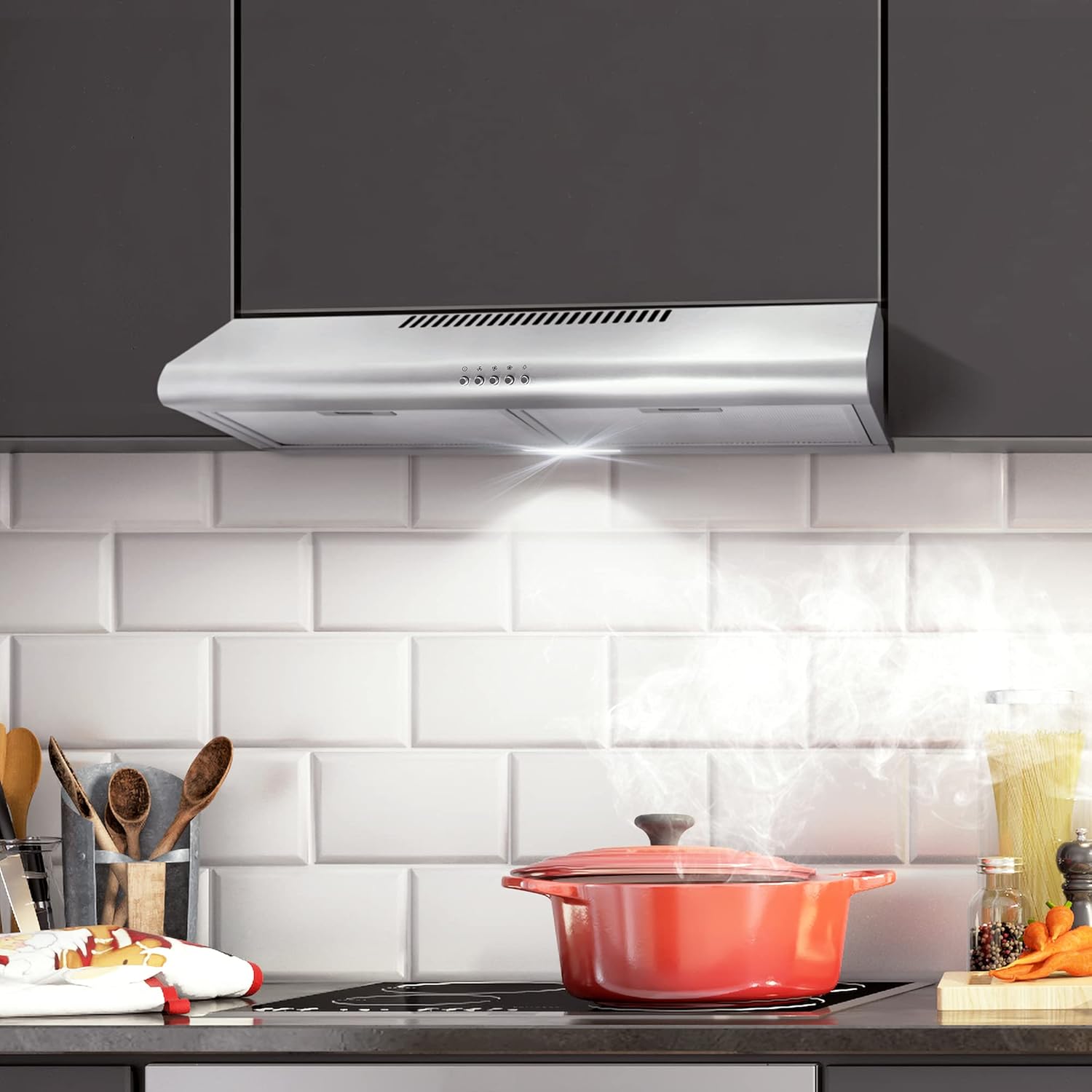
If you’ve ever watched the air above a gas burner shimmer and wondered what you’re actually breathing, this article is for you. When propane burns, it produces heat — but also carbon dioxide (CO₂), water vapor, and small amounts of carbon monoxide (CO, a colorless, odorless gas that’s harmful even at low concentrations). A range hood is the mechanical system — the fan-and-duct assembly mounted above your cooktop — that captures and exhausts those byproducts before they accumulate in your kitchen. On a propane range specifically, getting ventilation right matters more than it does on an electric cooktop, because you have an open-flame combustion appliance running inside your home. This guide walks through how to size a hood correctly, why “make-up air” (replacement air that flows back in to compensate for what the hood exhausts) is the piece most buyers miss, and what the research and owner reports say about which hood configurations actually work in real propane kitchens.
| EDITOR'S PICK[VIKIO HOME Under Cabinet Range…](https://www.amazon.com/dp/B0DSG57BDG?tag=greenflower20-20) | Mid-tier[COSMO COS-5MU30 30 in. Delta Co…](https://www.amazon.com/dp/B074PBLJVY?tag=greenflower20-20) | Budget pick[SNDOAS Range Hood 30 inch](https://www.amazon.com/dp/B0CM6FRW8N?tag=greenflower20-20) | |
|---|---|---|---|
| Control Type | Gesture & Touch | Button | Button |
| Max CFM | 980 | — | — |
| Ducting | Ducted | Ducted | Ducted/Ductless |
| Filters | — | Reusable | Aluminum |
| Price | $324.01 | $114.01 | $109.34 |
| See on Amazon → | See on Amazon → | See on Amazon → |
Why Propane Changes the Ventilation Equation
Electric ranges produce heat and grease vapor. Propane ranges do that and produce combustion byproducts at the burner — even when the burners are running clean.
The Propane Education & Research Council’s combustion chemistry overview explains the baseline: complete propane combustion (C₃H₈ + 5O₂) yields CO₂ and water vapor as primary outputs. In practice, burners in real kitchens don’t always achieve complete combustion — especially at high BTU loads, with heavy cookware blocking flame spread, or when LP pressure drifts slightly low in cold weather. Incomplete combustion adds CO and fine particulate matter to the mix. The California Air Resources Board’s 2023 update on indoor cooking air pollution found measurable CO and nitrogen dioxide (NO₂) spikes associated with high-BTU gas cooking even with hoods running — a data point that reinforces why CFM (cubic feet per minute — the volume of air a hood can move per minute) is not a number to guess at.
The specific propane-kitchen factors that increase your ventilation requirement:
- Higher BTU ceilings. Professional-grade propane ranges from BlueStar, Wolf, and ZLINE commonly reach 25,000–30,000 BTU per burner. Even mid-tier LP conversions from Frigidaire Gallery or Whirlpool run 12,000–18,000 BTU. More BTU = more combustion = more byproduct volume per unit time.
- LP gas burns slightly richer than natural gas. Because propane has higher energy density (2,516 BTU/cubic foot vs. ~1,030 for natural gas), LP-converted ranges are calibrated with smaller orifices, but combustion dynamics in the real burner environment still differ in ways that affect byproduct load.
- Rural and off-grid installations often have lower baseline ventilation. Tighter homes built for energy efficiency, cabins without mechanical ventilation systems, and RV-pad setups all create conditions where cooking byproducts accumulate faster.
CFM Sizing: The Math That Actually Matters
The Home Ventilating Institute’s Publication 920 is the industry’s primary residential sizing reference, and the IRC 2024 (Section M1503) is the code baseline inspectors work from. Here’s how to translate their guidance into a real number for your installation.
The HVI method for wall-mounted hoods:
CFM = (Cooktop width in inches × Cooktop depth in inches × BTU rating of highest-output burner) ÷ a fixed divisor
In practice, HVI 920 simplifies this to a rule that’s easier to apply: for a wall-mounted hood over a residential cooktop, calculate 1 CFM per 100 BTU of total cooktop output as a working floor. For a 36-inch propane range with four burners totaling 60,000 BTU, that’s 600 CFM minimum. Island installations add a 20–25% penalty because capture is less efficient without a wall backing the thermal plume.
By the Numbers
| Installation type | Minimum CFM (HVI 920 method) | Notes |
|---|---|---|
| Wall mount, ≤40,000 BTU total | 400 CFM | Entry-tier LP range |
| Wall mount, 40,000–70,000 BTU | 600–700 CFM | Mid- to high-tier 30–36” range |
| Island mount, same BTU range | Add 20–25% | Capture efficiency penalty |
| Pro-style, 90,000+ BTU (6-burner) | 900–1,200 CFM | Make-up air almost certainly required |
The IRC 2024 sets a code trigger at 400 CFM: any residential exhaust hood rated above 400 CFM requires evaluation for make-up air. Many jurisdictions have already adopted this threshold; some progressive codes (California’s Title 24, for instance) have lower triggers. Check with your AHJ (Authority Having Jurisdiction — the local building or mechanical inspector who signs off on your installation) before committing to a hood.
Make-Up Air: The Part Most Buyers Skip Until They Have a Problem
Here’s the scenario that plays out in owner forums repeatedly: a buyer installs a 900 CFM hood over a Wolf or BlueStar range, fires up all the burners, and watches the hood fail to capture the plume. Worse, the burner flames begin to flutter and pull sideways. The culprit is negative pressure — the hood is exhausting air faster than the house can replace it, creating a partial vacuum that distorts the thermal column the hood is trying to capture. In extreme cases, this negative pressure backdrafts other combustion appliances (water heaters, furnaces) — a genuine safety hazard that the ASHRAE Standard 62.2-2022 specifically addresses in its residential ventilation balance requirements.
Make-up air (sometimes called “replacement air” or “MUA”) is a supply-air system — typically a dedicated duct with a motorized damper that opens when the hood runs — that feeds outdoor air back into the kitchen zone to balance what’s being exhausted. Without it, high-CFM hoods create the problems above.
When do you need it?
The practical threshold used by most HVAC contractors working with propane kitchens is 600 CFM. Below that, typical home infiltration (air leaking in through gaps and the building envelope) usually compensates passively. Above 600 CFM — especially in well-sealed modern construction — a dedicated make-up air system is effectively mandatory for both performance and safety.
For a 36-inch professional propane range running 900+ CFM, plan the make-up air budget before you pick the hood. A basic passive MUA kit (a dedicated duct port with a motorized damper tied to the hood’s fan switch) runs $300–$700 installed by an HVAC contractor. Tempered make-up air units (which condition the incoming air so you’re not blasting cold outdoor air into the kitchen in January) run $1,500–$4,000 installed — a line item that surprises buyers who were mentally budgeting only for the hood itself.
One more make-up air nuance for propane kitchens specifically: because LP tanks can experience pressure variation in cold weather, the last thing you want is a combustion environment that’s also oxygen-depleted due to negative pressure. Owners of off-grid propane setups in cold climates report this as a real-world issue, not a theoretical one. PERC’s combustion guidance recommends treating any high-BTU propane installation as if it needs the same ventilation balance attention you’d give a commercial kitchen.
What Hood Configurations Actually Work
Not all hoods are equal on a propane range, and the configuration choice has real consequences.
Ducted vs. recirculating (ductless): Ducted hoods — which exhaust air to the outside through a duct — are the only type that actually remove combustion byproducts from the kitchen. Recirculating (ductless) hoods pull air through a charcoal filter and return it to the kitchen. They reduce grease and odor but do not remove CO, CO₂, or NO₂. For a propane kitchen, this is a non-negotiable distinction: ductless hoods are inadequate as primary ventilation over any gas or propane burner. The IRC 2024 Section M1503 reflects this by requiring ducted exhaust for new construction residential hood installations in most circumstances — ductless is carved out only for certain remodel scenarios where ducting is genuinely not feasible.
Chimney/wall-mount hoods: The standard form factor for most residential propane ranges. Capture efficiency is best when the hood projects at least 3 inches beyond the front burners and the hood face sits 24–30 inches above the cooking surface (manufacturer spec sheets vary — follow the AFF, or “above finished floor,” range in the installation manual). Owners of Wolf and BlueStar ranges consistently report that sizing the hood 6 inches wider than the range (so a 36-inch range gets a 42-inch hood) meaningfully improves capture of high-BTU side spill.
Liner/insert hoods: These are bare fan assemblies installed inside a custom cabinet structure — popular with kitchen designers who want a seamless look. The trade-off, noted across aggregated installer reviews, is that the cabinet enclosure can restrict airflow if the liner’s rated CFM isn’t matched carefully to the duct size. At 600+ CFM, duct diameter should be 8 inches minimum; 900+ CFM moves to 10 inches. Undersized ductwork is one of the most common reasons a high-rated hood underperforms in the field.
Downdraft systems: Built into the cooktop surface and pull air downward. Spec-sheet analysis shows these consistently require 50–100% more CFM than overhead hoods to achieve equivalent capture, because they fight the natural upward convection of the thermal plume. For high-BTU propane ranges, downdraft ventilation is generally not recommended — a position consistent with guidance from This Old House’s ventilation coverage and widely echoed by HVAC contractors who spec propane kitchen work.
Decision Framework: If X, Then Y
You’re staring at a spec sheet or a contractor quote. Here’s how to resolve the tradeoff tree:
If your propane range is ≤40,000 BTU total and you’re in a standard stick-built home: A quality 400–600 CFM ducted chimney hood with 6-inch duct will meet code and perform well. Make-up air is probably passive-adequate, but verify with your AHJ.
If your range is a 30–36” mid-tier LP conversion (Frigidaire Gallery, Samsung, Whirlpool) at 45,000–60,000 BTU total: Size for 600 CFM. Plan a 7- or 8-inch duct. Ask your HVAC contractor about passive MUA before finalizing the install.
If your range is a professional-grade propane unit (Wolf, BlueStar, Bertazzoni Pro, ZLINE Crown) at 60,000–90,000+ BTU: 900 CFM is your working floor. Budget for tempered make-up air if you’re in a well-sealed home or climate with cold winters. A 10-inch duct is not optional at this tier.
If you’re in an off-grid cabin or rural installation with no mechanical ventilation baseline: Add a 20% CFM buffer to any calculated minimum, install a CO/CO₂ detector at range height as a backup, and treat make-up air as mandatory regardless of CFM rating — the building envelope in these installs is often unpredictable.
If you’re designing an outdoor propane kitchen (Lynx, Blaze, Bull): Outdoor applications have natural make-up air and generally don’t require rated hood systems, but covered outdoor kitchens — pergolas, solid roof structures — do require ventilation planning. ASHRAE 62.2 doesn’t directly govern outdoor spaces, but the NFPA 54 National Fuel Gas Code has guidance on covered outdoor combustion appliance placement that’s worth reviewing with your installer.
Getting ventilation right isn’t the glamorous part of a propane kitchen build — but it’s the part that determines whether the range performs the way you paid for it, and whether the air you’re cooking in is actually safe. Size for the real BTU load, account for make-up air before the hood goes in, and specify ducted over ductless every time. Everything else is finish work.