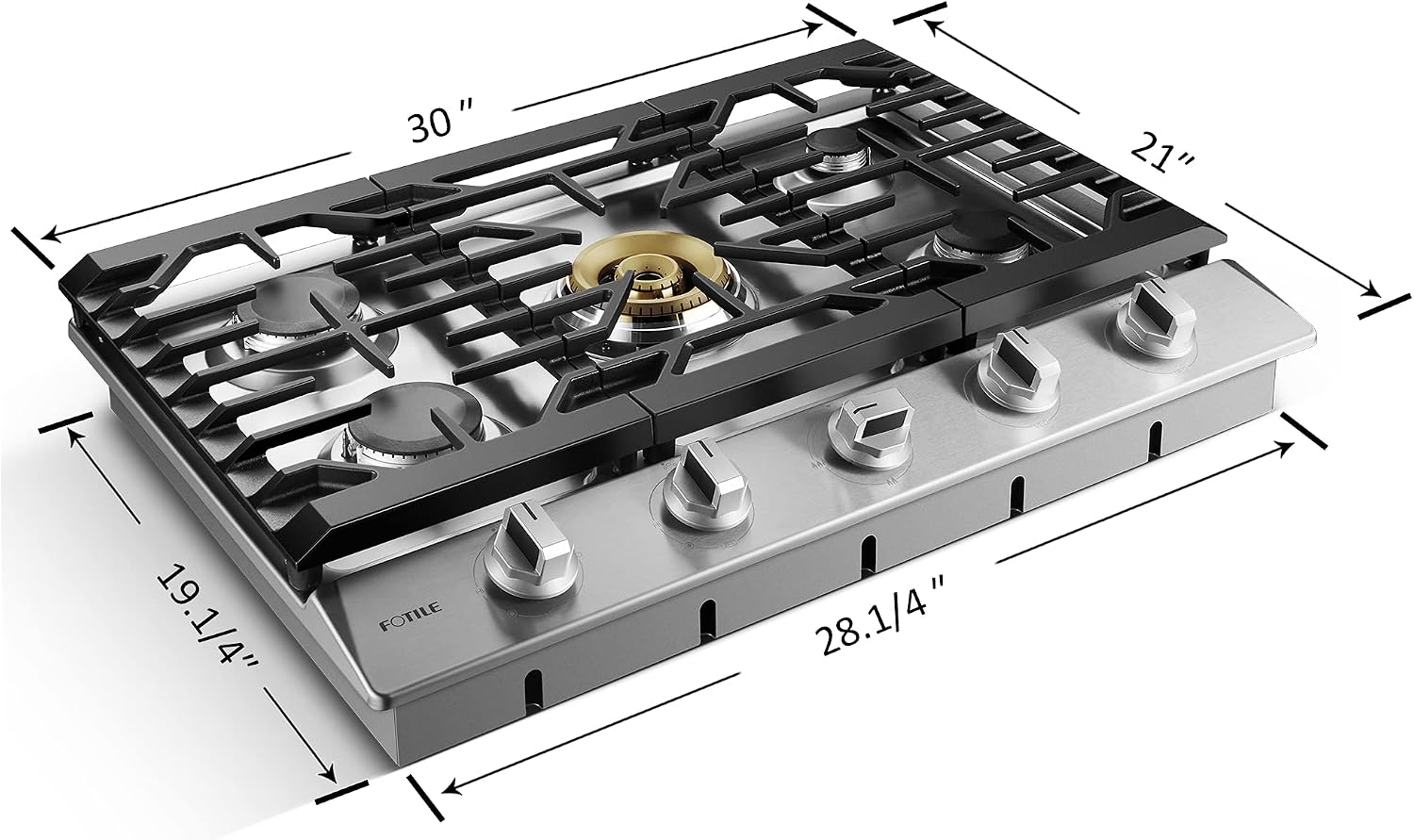
Built-in gas cooktops are exactly what they sound like: drop-in cooking surfaces that mount flush into a countertop, plumbed directly to a gas line rather than standing on their own. Most of the gas cooktops you’ll see at appliance showrooms are set up for natural gas — the utility-supplied fuel that runs through municipal pipelines at relatively low pressure. Propane (LP gas) is a different animal: it’s stored in tanks, delivered by truck, and arrives at the appliance at higher pressure than natural gas. That pressure difference means a cooktop factory-configured for natural gas will run inefficiently, burn with a yellow flame, and potentially create a carbon monoxide hazard if you hook it straight to a propane tank. The fix is an LP conversion kit — a set of replacement orifices (the small precision-drilled nozzles that meter gas into each burner) and a regulator adjustment that retunes the appliance for propane’s characteristics. This guide walks you through what that conversion actually involves, how BTU ratings translate to real cooking performance on LP, and which burner construction details separate a five-year cooktop from a ten-year one.
| EDITOR'S PICKFOTILE GLS30501 30” Stainless S… | Mid-tier[GASLAND 36 Inch Gas Cooktop](https://www.amazon.com/dp/B08LYYRRTD?tag=greenflower20-20) | Budget pick[Frigidaire Professional 36 Inch…](https://www.amazon.com/dp/B014VTZP6Y?tag=greenflower20-20) | |
|---|---|---|---|
| BTU max burner | 22,000 BTU | — | — |
| LP kit included | ✓ | — | ✓ |
| Griddle included | ✗ | ✓ | ✓ |
| Width | 30" | 36" | 36" |
| Price | $1,098.97 | $549.99 | |
| See on Amazon → | See on Amazon → | See on Amazon → |
Why LP Conversion Is More Than a Parts Swap
The orifice is the smallest and most consequential part in any gas cooktop burner. It’s a brass fitting roughly the size of a pencil eraser with a precision-drilled hole — often just 0.9 to 1.5 mm in diameter — that controls how much gas reaches the flame. Natural gas and propane have meaningfully different energy densities and require different fuel-to-air ratios to burn cleanly. According to propane.com’s overview of LP vs. natural gas appliance requirements, propane contains roughly 2,500 BTU per cubic foot compared to natural gas at around 1,030 BTU per cubic foot. That’s why LP orifices are drilled smaller: you need less gas by volume to hit the same BTU output.
When manufacturers sell a “convertible” cooktop, they include an LP conversion kit with pre-drilled propane orifices sized for each burner. The process involves removing each burner cap, unscrewing the natural gas orifice, and threading in the LP-rated replacement. Most also require adjusting a small low-simmer screw on the valve body to prevent the flame from extinguishing at minimum output — LP’s higher energy density can make low-flame stability tricky if that adjustment is skipped.
Where things go wrong: Kit quality varies dramatically. The Propane Education & Research Council’s Propane Appliance Conversion Technical Bulletin documents a consistent failure pattern — generic “universal” conversion kits sold by third-party retailers frequently use orifices drilled to approximate rather than brand-specific sizing tolerances. Owners across aggregated reviews of mid-range cooktops (Samsung, Frigidaire Gallery, Whirlpool) report uneven flame rings and premature igniter failure when non-OEM kits are used. The rule is straightforward: always use the manufacturer-supplied or manufacturer-approved LP kit for the specific model. If the cooktop didn’t ship with one, call the manufacturer directly and get the part number — don’t pull a generic kit off a warehouse shelf.
One more variable that’s easy to overlook: the regulator. Most built-in cooktops ship with a factory regulator set for natural gas at 7 inches of water column (in. W.C.) inlet pressure. LP systems run at 11 in. W.C. at the appliance inlet. The conversion kit should include either a replacement regulator or documented instructions for adjusting the existing one. If yours doesn’t, that’s a red flag about kit completeness.
BTU Output on Propane: What the Numbers Actually Mean
BTU — British Thermal Unit — is the standard measure of heat output for gas burners. A single BTU is the energy needed to raise one pound of water by one degree Fahrenheit. In cooking terms, it translates directly to how fast a burner brings a pot to boil, how well it sustains a hard sear, and how finely it holds a low simmer.
By the numbers — built-in cooktop BTU tiers:
| Tier | Power Burner | Simmer Burner | Typical Application |
|---|---|---|---|
| Entry (GE, Amana LP converts) | 9,500–12,000 BTU | 5,000 BTU | Everyday family cooking |
| Mid-range (Frigidaire Gallery, Bosch) | 15,000–17,000 BTU | 4,000–5,000 BTU | Serious home cooking |
| Premium (Wolf, BlueStar, Bertazzoni) | 18,000–23,000 BTU | 375–1,000 BTU (dual-stacked) | Professional-style output + precision |
A few important calibrations for propane specifically:
BTU ratings are stated for the fuel the appliance ships for. A cooktop rated at 18,000 BTU on natural gas will deliver approximately the same output on LP after proper conversion — the orifice swap is designed to maintain rated output, not reduce it. What changes is the flame character: LP burns hotter per cubic foot of gas, which is why the orifice is smaller, but the calibrated BTU output at the burner head should remain consistent. Serious Eats’ analysis of stovetop heat control notes that consistent BTU delivery across the flame ring — not just peak output — is what separates a well-engineered burner from one that creates hot spots.
The simmer end matters as much as the power end. A dual-stacked burner — found on Wolf, BlueStar, and Bertazzoni at the premium tier — uses two concentric rings of flame ports. The outer ring handles high heat; the inner ring alone can sustain outputs as low as 375 BTU, which is the range you need for holding a béchamel or melting chocolate without a diffuser pad. Entry and mid-range cooktops typically bottom out at 4,000–5,000 BTU even on the “simmer” setting, which requires more intervention (heat diffusers, pot lifting) for delicate tasks.
Burner Construction: What Separates a $900 Cooktop from a $4,500 One
This is where editorial analysis of published specs and owner reports diverges most sharply from spec-sheet comparisons alone.
Sealed vs. open burners. Nearly all built-in cooktops sold today use sealed burners — the burner is mounted directly to the cooktop surface with a gasket that prevents spills from reaching the gas ports below. Open burners, still found on BlueStar and a handful of professional-grade models, expose the burner head and allow easier cleaning and more direct flame contact with cookware. Owners of BlueStar open-burner models consistently report faster response to BTU changes and easier maintenance when burner ports clog with mineral deposits. The tradeoff: open burners require more attentive cleaning and don’t perform as well on very thin-bottomed cookware due to uneven flame distribution at the edges.
Burner cap material. Cast iron caps retain heat longer, which helps maintain BTU output when cold pots are placed on the burner — a useful characteristic for LP users in cold climates where tank pressure can fluctuate in low temperatures. Brass caps are more common at the premium tier; owners report better corrosion resistance over years of cooking with high-moisture dishes. Porcelain-coated steel caps, common at the entry tier, show the highest rate of chipping in long-term Consumer Reports reliability tracking — chipped porcelain can contaminate food and create ignition issues.
Igniter quality. This is the failure point most underweighted by buyers. The spark igniter electrode sits close to the burner, exposed to grease, moisture, and heat cycling. Consumer Reports’ gas cooktop reliability data consistently shows igniter failure as the leading reason for service calls on built-in cooktops within the first three years of ownership. Premium models from Wolf and BlueStar use ceramic-sheathed electrodes that owners report as substantially more durable; mid-tier models typically use bare-wire electrodes that require more frequent cleaning and show higher replacement rates at the five-year mark.
Grate design for LP use. LP flame geometry differs slightly from natural gas — the flame tends to be more concentrated at the center of the burner ring. Continuous cast-iron grates (one unbroken surface across all burners) help distribute heat more evenly by allowing pots to slide without lifting, and they provide more stable support for small pans over large burners. Segmented grates — individual trivets per burner — are easier to clean but force more pot-lifting and can wobble under heavy Dutch ovens. For LP users doing high-output cooking, continuous grates are consistently preferred in aggregated owner reviews.
LP Conversion Across the Market: Brand-Specific Patterns
Not all LP conversion programs are created equal, and this is where the intermediate buyer earns their edges.
Wolf (30- and 36-inch built-in cooktops): Wolf ships LP kits as a factory option — you specify at order. Their service documentation, per This Old House’s gas cooktop buying guide, is among the most complete in the industry, with model-specific torque specs for orifice installation. Owners in long-run reviews report near-zero conversion-related issues when the factory kit is used. The caveat: Wolf’s LP kits are not inexpensive (typically $85–$150 depending on burner count), and installation labor at a Wolf-authorized technician can add $200–$400 depending on region.
BlueStar: BlueStar builds its ranges and cooktops for either fuel at the factory — you choose at configuration, not after the fact. This matters because the manifold, valves, and orifices are purpose-built rather than adapted. Owners report this as a meaningful reliability advantage, particularly on the simmer burners where LP calibration is most sensitive. ANSI Z21.1, the household cooking gas appliance standard, requires that all converted appliances meet the same performance criteria as factory-configured units — but purpose-built LP configuration sidesteps conversion variability entirely.
Mid-tier (Frigidaire Gallery, Bosch 500-series, Samsung): These brands offer conversion kits as included accessories or low-cost add-ons ($20–$50). The kits are generally adequate when installed correctly, but owner reports cluster around two issues: incomplete low-simmer valve adjustment (resulting in flame-out at minimum setting) and generic electrode spacings that require fine-tuning post-installation. If you’re buying in this tier for an off-grid or rural installation, budget time for post-conversion calibration — it’s frequently a 30-minute adjustment, not a one-and-done swap.
The Decision Frame: If X, Then Y
Here’s how to resolve the tradeoffs above into a clear buying path:
If you’re installing in a primary residence with full LP infrastructure and a $3,000+ budget: Specify LP at the factory (BlueStar) or order the OEM LP kit at the same time as the cooktop (Wolf, Bertazzoni). Budget $250–$500 for a licensed gas technician to handle the conversion and pressure test. The dual-stacked burner premium is worth it if you cook sauces, braises, or anything requiring sustained low heat.
If you’re outfitting an off-grid cabin or rural property on a mid-range budget ($800–$1,500): Frigidaire Gallery and Bosch 500-series offer the best documented LP conversion support in this tier. Prioritize models with cast-iron burner caps and ceramic-sheathed electrodes — the igniter replacement cost on a remote property is not just a parts cost, it’s a service-call cost. Avoid any model where the LP kit is listed as “sold separately” without a published part number.
If you’re sourcing for an outdoor kitchen (Lynx, Blaze, Bull): These brands design for LP as the primary fuel — natural gas is often the conversion option, not the reverse. Confirm LP orifice sizing matches your tank regulator output pressure, and verify that the model carries a current UL listing for outdoor installation. Propane.com notes that outdoor LP appliances require specific regulator configurations distinct from indoor installations.
The LP conversion question is really a quality-of-information question: does the manufacturer treat propane as a first-class fuel or an afterthought? The answer to that question, more than any single BTU number, is what determines whether your cooktop performs flawlessly for a decade or becomes a recurring service headache.